Colour Correcting Makeup 101
· 7 min read
This post contains affiliate links.
As an Amazon Associate I earn from qualifying purchases
🇬🇧 As I continue to receive your many encouragements and messages on the different platforms we’re currently the most active on (thank you!), a very interesting trend is emerging and it’s one that I did not expect. There’s a huge demand for information about makeup and my skincare junkie self is surprised. The makeup board on Bãlkis’ Pinterest (you can follow us here) is the top board and I am now extremely happy that I paid attention all those times that I was in the makeup chair.
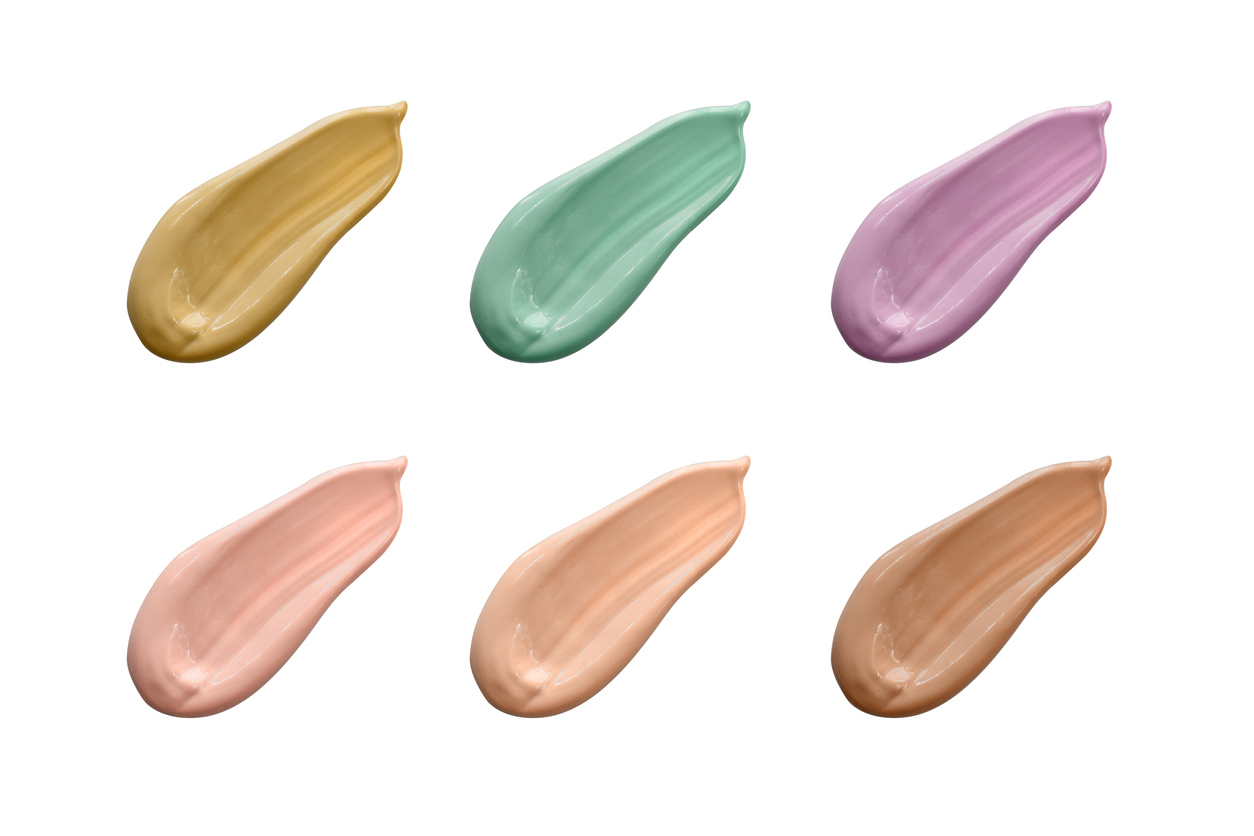
So I will be covering makeup more than I had originally intended to and I wanted to start with colour correcting. I know quite a few of you are probably still confused when you see these green or lavender colours in palettes like the NYX one below, even if colour correcting is becoming more mainstream.


But it’s actually a very simple concept. Colours that are on opposite sides of each other on the colour wheel (please see the image below), complimentary colours, will neutralize each other.
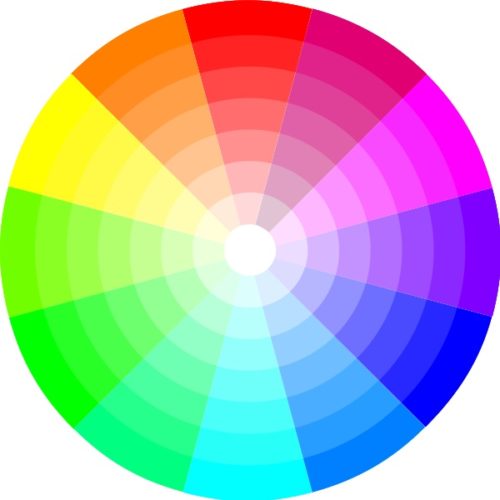
So the same way red is on the opposite side of green on the colour wheel, any redness you have in your skin (from blemishes, rosacea, blotchy skin) will be neutralized by using a green colour correcting product.
The advantage of colour correcting is to have a more natural look with your makeup. Being able to mute discolorations, redness, dark marks or dark circles BEFORE you apply your other products saves you from having to pack them on and gives you a more natural finish. If an area of concern is still showing after you’ve applied your foundation or/and your concealer, then you need to use a colour corrector.
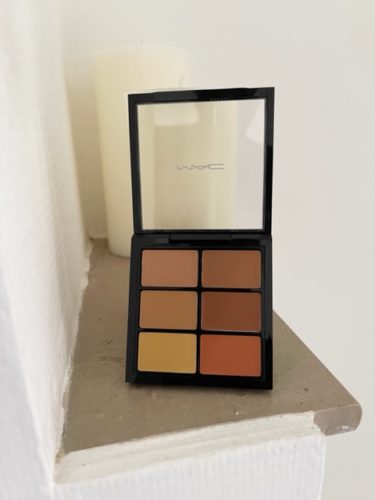
You need to colour correct according to your skin tone. If you have a fair to light complexion, you need to choose light, pastel-like colour correcting shades, lavender for example. If you have a light to medium complexion, you can go for more vivid, vibrant colours and even more intense ones if you have a medium to dark skin tone. I wouldn’t for example use this orange in the very popular Mac Studio Fix Conceal and Correct palette (on the lower right hand side of the photo below). It would be too rich for my complexion. For someone darker than me however, it can bring out real warmth to those areas that have hyperpigmentation including dark circles.
You don’t want your colour corrector to show through your makeup, it has to be as pigmented AS your skin tone.
And that’s also the reason why you need to be very light-handed when using these products. You’re only meant to apply colour correctors to the problem area. Start light and build up as needed using a soft brush on larger areas or your fingers if just covering a small spot. Always apply colour correctors first, before foundation or/and concealer. Think of them as a base for your makeup.
The key here is blending (it is for makeup in general but is especially important when applying colour correctors). Colour correctors come in both liquid and solid form but I personally prefer the latter, you will get more coverage out of a creamy texture.
THE RAINBOW CONNECTION
Purple, lavender, lilac, mauve
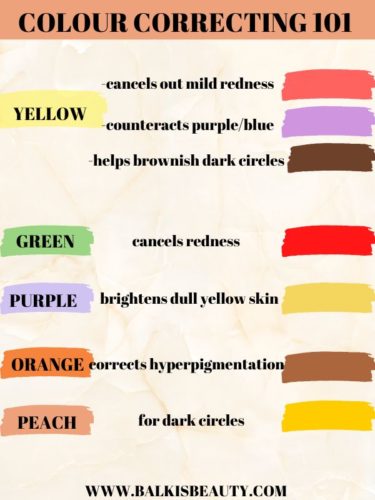
Excellent for sallow skin with yellow undertones, apply all over to brighten the face.
Green
Green is used to cancel out redness in the skin, but only in fairer to medium skin tones. Using a primer like the one below from NYX will help to not overdo it


Yellow, peach
Yellows will cover bluish-purple dark circles and help violet undertoned skins. Yellow also cancels out mild redness. A peachy colour will help brownish dark circles.
If you’re on the Fair end of the spectrum and want to cover visible veins or dark circles, this popular product from L.A. Girl is at a decent price and delivers


Orange, peach (pinkish/salmon), red
Good at bringing warmth, if you have dullness around the mouth for example, in medium to dark skin tones, or to cover very dark or bluish dark circles and bruises. The darker the skin the more you’ll go towards reds.
If you have warm undertones to your skin, the Mac Studio Fix Conceal&Correct palette is a classic and comes in 6 different intensity from Light to Extra Deep, if you have cooler undertones, this one from Bobbi Brown, the Queen of colour correcting (the choice of shades is unmatched), is a pink type of peach


© N’Deye S. Somparé
LE MAQUILLAGE CORRECTEUR
🇫🇷 Alors que je continue de recevoir vos nombreux encouragements et messages sur les différentes plateformes sur lesquelles nous sommes le plus actif (merci!), une tendance très intéressante se dessine et une à laquelle je ne m’attendais pas. Il y a une grosse demande d’informations sur le maquillage et pour la folle de soins de la peau que je suis c’est très surprenant. Notre board Maquillage sur Pinterest (vous pouvez le consulter ici) est le plus populaire et je regarde maintenant les longues heures que j’ai passées dans les chaises des maquilleurs avec gratitude.
Nous allons donc beaucoup plus parler de maquillage et je voulais commencer par vous expliquer le maquillage correcteur. Je suis certaine que beaucoup d’entre vous se sentent peut-être encore assez perdues quand vous tombez sur ces palettes arc-en-ciel même si l’usage de ces produits devient de plus en plus courant.
Mais c’est en fait un concept assez simple qui nous ramène à la théorie des couleurs et à la roue chromatique: les couleurs qui sont à l’opposé les unes des autres sur la roue (les couleurs complémentaires) se neutralisent entre elles.
Donc de la même façon que le vert est à l’opposé du rouge sur la roue chromatique, si vous avez des rougeurs (dues à des imperfections ou à la couperose), elles seront neutralisées en utilisant un correcteur de couleur verte.
L’avantage du maquillage correcteur c’est de vous permettre de garder un look naturel malgré les imperfections. Plutôt que de camoufler en étalant des couches épaisses de fond de teint et/ou d’anti-cernes, on CORRIGE les cernes, taches et rougeurs avant même de se maquiller.
Si vous constatez après vous être maquillée que ces problèmes sont encore visibles alors vous avez besoin de produits correcteurs du teint.
Vous devez aussi utiliser ces produits selon votre teint. Les peaux plus claires pourront utiliser des couleurs pastels tandis qu’une peau plus mate se dirigera vers des couleurs plus soutenues (corail) et que les peaux foncées peuvent utiliser des oranges et des rouges sans problème. Le correcteur ne doit pas se voir à travers le maquillage, il faut donc le choisir en function de la pigmentation de la peau.
Et c’est la raison pour laquelle il faut avoir la main légère lorsqu’on utilise ces produits. Il ne faut les appliquer que sur la zone concernée et en mettre un tout petit peu au départ (surtout si on n’a pas l’habitude de les utiliser) pour ensuite en rajouter petit à petit selon les besoins. Utiliser une brosse fine sur les zones importantes (en cas de rougeurs par exemple) et vos doigts si vous corrigez une petite section de la peau (sur un bouton par exemple). Il faut les appliquer en premier, avant votre fond de teint et/ou votre anti-cernes. Considérez ces produits comme une base de votre maquillage.
Comme pour tout le maquillage, mais encore plus ici, il faut bien fondre les couleurs entre elles.
Les produits correcteurs en Maquillage existent sous forme liquide ou crèmeuse mais je recommande ces derniers car ils vont mieux neutraliser la couleur.
Les violets sont excellents pour réveiller les teints cireux aux sous-tons jaunes. Appliquer partout pour illimuner le visage.
Le vert comme nous l’avions expliqué plus haut est utilisé pour neutraliser les rougeurs chez les peaux claires à moyennes. Utilisez un primer est une bonne façon de ne pas avoir la main lourde.
Le jaune neutralise le violet, il est donc utilisé chez les peaux claires aux sous-tons chauds pour couvrir des cernes violets. Il aide aussi à réduire les rougeurs diffuses. Pour les cernes brunes un pêche corail fera l’affaire.
Les couleurs plus intenses comme les oranges ou rouges sont réservées aux peaux foncées, si vous voulez réchauffer le pourtour des lèvres ou recouvrir des cernes bien marquées. Plus la peau est foncée, plus le correcteur tend vers le rouge.
Les pêches que l’on retrouve ici tendent vers le rose saumon et conviennent aux peaux aux sous-tons froids.
© N’Deye S. Somparé

N'Deye
Esthetician trained at Aveda in New York, with a specialization in aromatherapy. I created BalkisBeauty to help you see through the gimmicks and find what works for you.
Read my story →