Purging vs. Breakout: How to Tell the Difference
· 7 min read
🇬🇧 Started a new skincare product and suddenly your skin is covered in spots? Before you panic and throw the product away, there’s an important question to ask: are you experiencing skin purging or a breakout?
Although they can look similar, skin purging and acne breakouts aren’t the same thing.
Understanding the difference can help you decide whether to continue using a new product or stop before you cause more irritation and inflammation.
WHAT IS SKIN PURGING?
Skin purging is a temporary increase in breakouts that can happen when you introduce certain skincare ingredients that increase skin cell turnover.
The most common ingredients associated with purging include:
- Retinol and retinal
- Prescription retinoids
- Alpha hydroxy acids (AHAs), such as glycolic and lactic acid
- Beta hydroxy acid (BHA), particularly salicylic acid
These ingredients can speed up the process of bringing existing microcomedones — clogged pores that haven’t yet become visible — to the surface.
The result? Your skin may temporarily look worse before it looks better.
WHAT DOES SKIN PURGING LOOK LIKE?
Purging usually appears in areas where you normally experience acne or clogged pores. You may notice:
- Small whiteheads or blackheads
- Small pimples
- Increased congestion
- Breakouts appearing relatively quickly after starting an active ingredient
The important clue is location. If you’re suddenly breaking out in an area where you never normally get spots, purging is less likely.
WHAT IS A BREAKOUT?
A regular acne breakout can be caused by many things, including hormonal fluctuations, stress, irritation, bacteria, occlusive skincare products or a damaged skin barrier.
Unlike purging, a breakout isn’t necessarily caused by increased cell turnover.
You may also experience contact irritation or a reaction to a skincare product, particularly if your skin becomes itchy, burning, red, swollen or unusually sensitive.
If a new product causes widespread irritation or breakouts in unusual areas, it’s a good reason to stop using it.
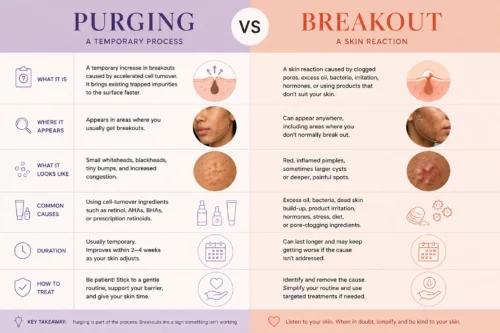
PURGING VS. BREAKOUTS: THE KEY DIFFERENCES
| Skin Purging | Regular Breakout |
| Usually triggered by cell-turnover ingredients | Can have many different causes |
| Usually occurs where you normally break out | Can appear anywhere |
| Often involves small pimples or clogged pores | Can include larger, inflamed acne |
| Should gradually improve | May continue or worsen |
| Usually temporary (4 to 6 weeks) | Doesn’t necessarily resolve quickly |
HOW LONG DOES SKIN PURGING LAST?
This is where patience matters.
A purge shouldn’t continue indefinitely. Your skin should gradually settle as it adjusts to the new ingredient.
If your skin continues getting significantly worse, becomes increasingly irritated, or doesn’t begin improving, don’t assume you simply need to “push through” it.
More isn’t always better when it comes to active skincare ingredients.
HOW TO PREVENT SKINCARE PURGING FROM BECOMING AN IRRITATION?
If you’re introducing a retinoid, exfoliating acid or another active ingredient, start slowly.
Use the product less frequently at first and avoid introducing several new active ingredients at the same time. Keep the rest of your routine simple with a gentle cleanser, moisturiser and broad-spectrum sunscreen.
This is particularly important if you have sensitive skin or are prone to post-inflammatory hyperpigmentation (PIH). Excessive inflammation can leave behind dark marks long after the original breakout has disappeared.
And remember: purging isn’t a requirement for effective skincare. If a product doesn’t make you purge, that doesn’t mean it isn’t working.
THE BOTTOM LINE
The easiest way to remember the difference between purging vs breakouts is to look at what ingredient you’re using, where the spots appear and how your skin feels.
If you’re using an ingredient that increases cell turnover and you’re experiencing temporary congestion in your usual breakout areas, you may be experiencing skin purging.
But if you’re developing acne in unusual areas, significant irritation, burning or persistent worsening, you’re more likely dealing with a breakout or skin reaction, and continuing to use the product may not be the answer.
When in doubt, simplify your skincare routine and give your skin a chance to recover.
Healthy skin doesn’t need to suffer to improve.
© N’Deye S. Somparé
PURGE OU POUSSÉE D’ACNÉ: COMMENT FAIRE LA DIFFÉRENCE
🇫🇷 Vous avez commencé un nouveau produit de soin et, soudainement, votre peau est couverte d’imperfections ? Avant de paniquer et d’abandonner le produit, il est important de se poser une question : s’agit-il d’une purge cutanée ou d’une poussée d’acné ?
Bien qu’elles puissent sembler similaires, la purge cutanée et les poussées d’acné ne sont pareilles. Comprendre la différence peut vous aider à déterminer s’il faut continuer à utiliser un nouveau produit ou l’arrêter avant de provoquer davantage d’irritation et d’inflammation.
Qu’est-ce qu’une purge cutanée ?
La purge cutanée est une augmentation temporaire des imperfections qui peut apparaître lorsque vous introduisez certains actifs qui accélèrent le renouvellement cellulaire.
Les ingrédients les plus souvent associés à la purge comprennent :
- Le rétinol et le rétinal
- Les rétinoïdes sur prescription
- Les acides alpha-hydroxylés (AHA), comme l’acide glycolique et l’acide lactique
- Le bêta-hydroxy acide (BHA), notamment l’acide salicylique
Ces ingrédients peuvent accélérer le processus qui fait remonter à la surface les microcomédons, des pores obstrués qui ne sont pas encore visibles.
Le résultat ? Votre peau peut temporairement sembler pire avant de commencer à s’améliorer.
À quoi ressemble une purge cutanée ?
La purge apparaît généralement dans les zones où vous avez habituellement des boutons ou des pores obstrués. Vous pouvez observer:
- De petits points blancs ou points noirs
- De petits boutons
- Davantage de congestion
- Des imperfections qui apparaissent relativement rapidement après l’introduction d’un actif
L’indice le plus important est la zone où apparaissent les imperfections. Si vous commencez soudainement à avoir des boutons dans une zone où vous n’en avez habituellement jamais, il est moins probable qu’il s’agisse d’une purge.
Qu’est-ce qu’une poussée d’acné ?
Une poussée d’acné classique peut être provoquée par de nombreux facteurs : les fluctuations hormonales, le stress, l’irritation, les bactéries, certains produits de soin trop occlusifs ou une barrière cutanée fragilisée.
Contrairement à la purge, une poussée d’acné n’est pas nécessairement liée à l’accélération du renouvellement cellulaire.
Vous pouvez également souffrir d’une irritation ou d’une réaction à un produit de soin, notamment si votre peau devient irritée, brûle, démange, gonfle ou devient particulièrement sensible.
Si un nouveau produit provoque une irritation importante ou des imperfections dans des zones inhabituelles, il est préférable d’arrêter de l’utiliser.
Purge ou poussée d’acné : les principales différences
| Purge cutanée | Poussée d’acné |
| Généralement déclenchée par des actifs qui accélèrent le renouvellement cellulaire | Peut avoir de nombreuses causes |
| Apparaît généralement dans les zones où vous avez habituellement des imperfections | Peut apparaître n’importe où |
| Se manifeste souvent par de petits boutons ou des pores obstrués | Peut inclure des boutons plus volumineux et inflammatoires |
| Devrait progressivement s’améliorer | Ne disparaît pas nécessairement rapidement |
| Est généralement temporaire (4 à 6 semaines) | Peut persister ou s’aggraver |
Combien de temps dure une purge cutanée ?
C’est ici que la patience est importante.
Une purge ne devrait pas durer indéfiniment. Votre peau devrait progressivement commencer à se stabiliser à mesure qu’elle s’adapte au nouvel actif.
Si votre peau continue à se détériorer de manière importante, devient de plus en plus irritée ou ne montre aucun signe d’amélioration, ne partez pas du principe que vous devez simplement “tenir bon”.
Utiliser davantage d’actifs n’est pas toujours la meilleure solution pour améliorer sa peau.
Comment éviter qu’une purge ne se transforme en irritation ?
Si vous introduisez un rétinoïde, un exfoliant acide ou un autre actif, commencez progressivement.
Utilisez le produit moins fréquemment au début et évitez d’introduire plusieurs nouveaux actifs en même temps. Gardez le reste de votre routine simple avec un nettoyant doux, une crème hydratante et une protection solaire à large spectre.
C’est particulièrement important si vous avez la peau sensible ou si vous êtes sujette à l’hyperpigmentation post-inflammatoire (HPI). Une inflammation excessive peut laisser des taches foncées longtemps après la disparition du bouton initial.
Et surtout : avoir une purge n’est pas indispensable pour qu’un produit soit efficace. Si un produit ne provoque aucune purge, cela ne signifie absolument pas qu’il ne fonctionne pas.
En résumé
Pour retenir facilement la différence entre purge et poussée d’acné, observez l’actif que vous utilisez, l’endroit où apparaissent les imperfections et la façon dont votre peau réagit.
Si vous utilisez un actif qui accélère le renouvellement cellulaire et que vous observez temporairement davantage d’imperfections dans vos zones habituelles, il peut s’agir d’une purge cutanée.
En revanche, si vous développez de l’acné dans des zones inhabituelles, une irritation importante, des sensations de brûlure ou une aggravation persistante, il s’agit probablement davantage d’une poussée d’acné ou d’une réaction cutanée, et continuer à utiliser le produit n’est peut-être pas la solution.
En cas de doute, simplifiez votre routine et laissez à votre peau le temps de récupérer.
Une peau saine n’a pas besoin de souffrir pour s’améliorer.
© N’Deye S. Somparé

N'Deye
Esthetician trained at Aveda in New York, with a specialization in aromatherapy. I created BalkisBeauty to help you see through the gimmicks and find what works for you.
Read my story →