« Clean » beauty Apps: yuka
· 9 min read

🇬🇧 You probably can tell by the quotes I put the word clean in that I’m not a big believer of clean beauty. Despite legitimate concerns on consumers’ part, a need for more transparency in the Beauty industry, and a real desire to do better from some brands, I don’t buy into the fear mongering that some Marketing heads figured would make them more money without having to actually invest in serious Research&Development.
And riding that wave are all these applications that appeared in the last few years that let you scan your products to give you the list of ingredients in them, while rating them according to how dangerous they can be for you, completely ignoring the importance of dosage and formulation for cosmetics.
But I was still curious to see how some of my products fared and decided to download the French application Yuka, which was created in 2017 by a group of business school graduates and an electronic engineering school alumni. They had a nutritionist added to the mix as the app was originally meant for food and only expanded to personal care products later on. It is still worth noting that they don’t have a toxicologist or a chemist in the lead team. With more than 500 000 beauty products in its database, Yuka has expanded to 12 countries including the U.K. in those 6 years and has influenced some of the industry players to clean their act. Mathilde Thomas, founder of natural French brand Caudalie does take into account Yuka’s ratings in her strategy to rid her products of “nasties”: parabens, phenoxyethanol, silicons or PEGs (petroleum based compounds). And there are more. The disturbing thing with this is that we might end up with products that are only formulated to be compatible with these apllications instead of products in search of results.
When you scan a product, controversial ingredients in the INCI (International Nomenclature of Cosmetic Ingredients) list are assigned a yellow dot if they’re considered low risk, an orange one for moderate risk and a red one if the ingredient has been recognized as dangerous. The green dot is for the ingredients that are considered safe to use. The product’s overall score is based on the level of the ingredient with the highest risk.
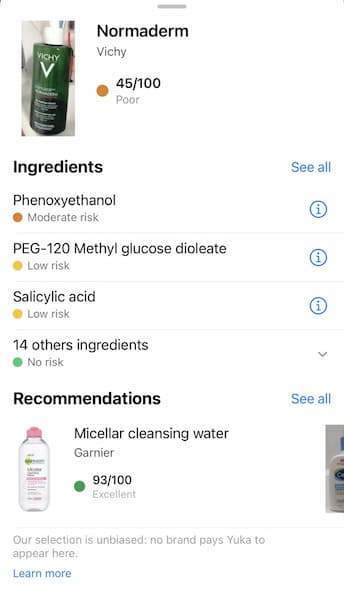
If a product is considered “bad”, the app can recommend a healthier alternative and this sounds very clever at first but it’s also the exact moment I start realising how limited this method can be, and how incomplete this is. My beloved Normaderm face wash (Vichy) is rated poorly due to the presence of phenoxyethanol, a preservative very commonly found in Cosmetics.
But the app then recommends micellar water as a replacement for it. From the perspective of someone who’s into beauty products, recommending micellar water as an alternative for face wash is a very strange thing to do. They don’t do the same thing at all. And I can’t help but wonder how does that play out if someone with sensitive skin is offered potentially irritating alternatives for their skin condition. I have, maybe, outgrown? micellar water and it is something I will talk about very soon and it’s not my first choice as a makeup remover especially for sensitive skins.
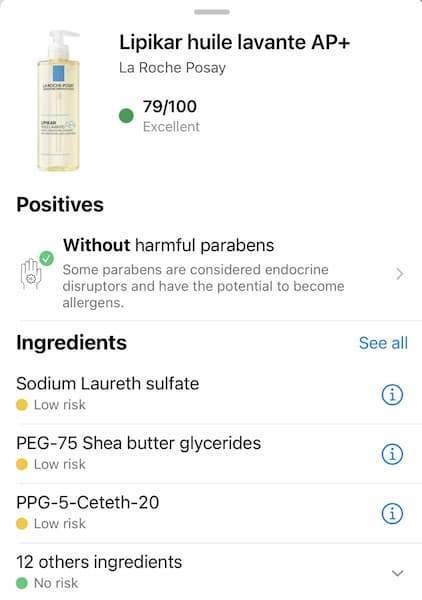
On the other hand, La Roche Posay’s Lipikar AP+ Cleansing Oil which has Sodium Laureth Sulfate as its 4th ingredient (so quite an important quantity of it as INCI lists are from higher concentration to lowest) while claiming to be gentle enough for eczema prone skins like mine (when I saw how it was foaming I knew something was not quite adding up) is well rated. This shows the limits of these applications. All they can do is detect the presence of potentially risky ingredients.
There is a widespread suspicion that these applications might be paid by brands for better ratings. Other apps like ThinkDirty do charge for some brands to be “verified” and also make brands pay an initial one-time fee of about 300 U.S. Dollars per product before charging a monthly, quarterly or yearly fee, which de facto excludes smaller brands. But Yuka is adamant that the Premium version of the app and a French book on nutrition, as well as a French and Spanish version of a calendar on seasonal fruits and vegetables, is what fund them.
Other apps similar to Yuka include the aforementioned ThinkDirty, INCI Beauty and EWG. The interesting thing about all of them is that an ingredient can be considered “bad” on one app, but not on another. It would make more sense if all the ingredients that can pose a potential problem were listed in the same way everywhere and their potential effects on some people listed.
My take on these applications is that they can help the average customer decode INCI lists, they’re not always easy to read if you’re not used to the beauty jargon. But they’re certainly not something to go by in vetting your personal care products. Thinking that just one ingredient makes a product completely useless is not very credible, if only from a scientific perspective. If you have any concerns about the safety of ingredients, the Cosmetic ingredient Review is a very helpful website https://www.cir-safety.org It was established more than 45 years ago with the help of the F.D.A. (Food&Drug Administration). This is a more serious approach if you need to be better informed on ingredients and their current status with the scientific community.
Have you tried any of these apps and what do you think a “cleaner” beauty product is? And is there a major concern for you when it comes to ingredients that are considered ‘suspect’?
© N’Deye S. Somparé
Les Applis de « clean Beauty »: yuka
🇫🇷 Je pense qu’il ressort clairement de mon usage des guillemets avec le mot “clean” que je ne suis pas très fan de cette catégorie aujourd’hui très en vogue sur la planète Beauté. Malgré des inquiétudes et une remise en cause légitimes de la part des consommateurs, un besoin de davantage de transparence dans l’industrie et une démarche sincère de la part de certaines marques, je ne suis pas convaincue que certains directeurs Marketing n’ont pas découvert là le filon parfait en jouant sur les peurs contemporaines plutôt que d’investir dans la Recherche et le Développement.
Et surfant sur cette vague, on retrouve donc toutes ces applications qui sont apparues ces dernières années qui vous permettent de scanner vos produits pour ensuite vous donner une liste d’ingrédients classifiés selon leurs risques potentiels. La quantité de l’ingrédient en question, la formulation prise dans son ensemble ou la balance riques-bénéfices ne sont pas pris en compte.
Mais j’avais quand meme la curiosité de voir quel était le verdict pour certains de mes produits et j’ai donc téléchargé Yuka, qui a été créée en France par un groupe de jeunes issus d’écoles de commerce et d’ingénierie électronique. Un nutritionniste a complété l’équipe car Yuka était au départ destiné à l’alimentation, ce n’est qu’après qu’ils se sont investis dans les cosmétiques. Il est intéressant de noter qu’il n’y a nulle part dans l’équipe mise en avant de toxicologue ou de chimiste. Yuka compte 500 000 références de produits de beauté et est désormais disponible dans 12 pays dont le Royaume-Uni. Elle influence certaines marques à améliorer leur offre “clean”. Mathilde Thomas créatrice de la marque Française de vinothérapie Caudalie tient compte des évaluations de Yuka dans sa straégie de naturalité: parabènes, phénoxyéthanol, silicones ou PEG ont tous été retirés de leurs formules et c’est une liste non exhaustive. Le danger est de se retrouver avec des formules cosmétiques pensées uniquement pour etre compatibles avec ces applications et non en quête d’efficacité.
Lorsque vous scannez un produit, les ingrédients controversés de la liste INCI (la nomenclature internationale des ingrédients cosmétiques) sont classés avec un point jaune si l’ingrédient est à faible risque, un point orange si le risque est modéré et un point rouge si l’ingrédient est vraiment mauvais. Le point vert signifie que l’ingrédient est sans risque. La note finale est basée sur l’ingrédient le plus risqué.
Si un produit est considéré comme mauvais, l’application peut recommender un meilleur produit et j’ai à peine eu le temps de trouver ça assez intéressant que je déchante très vite. Mon gel nettoyant Normaderm (Vichy) que j’utilise depuis longtemps a une note de 45/100 du à la présence de phénoxyéthanol, un conservateur courant en Cosmétique qui permet donc de préserver la qualité du produit et d’éviter la prolifération de microbes.
Mais l’application me recommande une eau micellaire comme alternative: extrêmement étrange, ce ne sont pas du tout les meme produits. Et j’imagine sans peine quelles conséquences cela pourrait avoir si une personne à la peau sensible se voit offrir des alternatives non adaptées à leur condition. Je suis revenue des eaux micellaires et c’est un sujet que nous aborderons très prochainement. Ca ne serait pas mon premier choix et surtout pas pour une peau sensible.
Par contre l’Huile Lavante AP+ Lipikar de la Roche-Posay qui a du sodium laureth sulfate en 4ème position dans sa liste d’ingrédients (les listes INCI listent les concentrations de façon décroissante donc une 4ème position indique une quantité importante) est considérée comme excellente avec une note de 79/100. Pour un produit sensé être “safe” pour les peaux atopiques, avoir cette quantité de sodium laureth sulfate est une aberration. Je me suis tout de suite demandée en l’utilisant pourquoi il moussait autant. Le sodium laureth sulfate est un tension-actif qui est beaucoup trop agressif surtout pour une peau à eczéma comme la mienne. Ça montre bien les limites de ces outils modernes.
Il y a aussi une forte suspicion autour de ces applications qu’elles sont payées par les marques. Certaines, comme ThinkDirty, ont effectivement une liste de marques “vérifiées” qui payent pour l’être et appliquent également des frais d’entrée d’à peu près 300 Dollars US par produit auxquels il faudra rajouter un abonnement mensuel, trimestriel ou annuel ce qui exclut tout de suite les marques plus petites. Yuka dit être financée grace à la version Premium de l’application, leur “Guide de l’alimentation saine” et le calendrier des fruits et légumes de saison qu’ils vendent sur leur site.
D’autres applications similaires à Yuka en dehors de ThinkDirty sont INCI Beauty et EWG. Et d’une application à l’autre, un meme ingrédient peut etre soit consideré comme mauvais ou ne pas l’être. Un manque certain de crédibilité, il serait beaucoup plus cohérent que toutes listent tous les ingrédients polémiques et expliquent leurs effets selon la personne qui les utilisent.
En conclusion, je pense que ces applications peuvent se révéler utiles au consommateur pour l’aider à décrypter les listes INCI, ells ne sont pas toujours faciles à comprendre. Mais ce ne sont pas du tout des outils pour choisr vos produits de soins et cosmétiques. Juger une formule entière sur un ou deux ingrédients n’est pas très sérieux ne serait-ce que d’un point de vue scientifique.
Avez-vous l’une de ces applications et comment décririez vous un produit de beauté “clean”? Est-ce que vous êtes préoccupés par tous les ingrédients suspectés d’être des perturbateurs endocriniens ou des allergènes?
© N’Deye S. Somparé

N'Deye
Esthetician trained at Aveda in New York, with a specialization in aromatherapy. I created BalkisBeauty to help you see through the gimmicks and find what works for you.
Read my story →